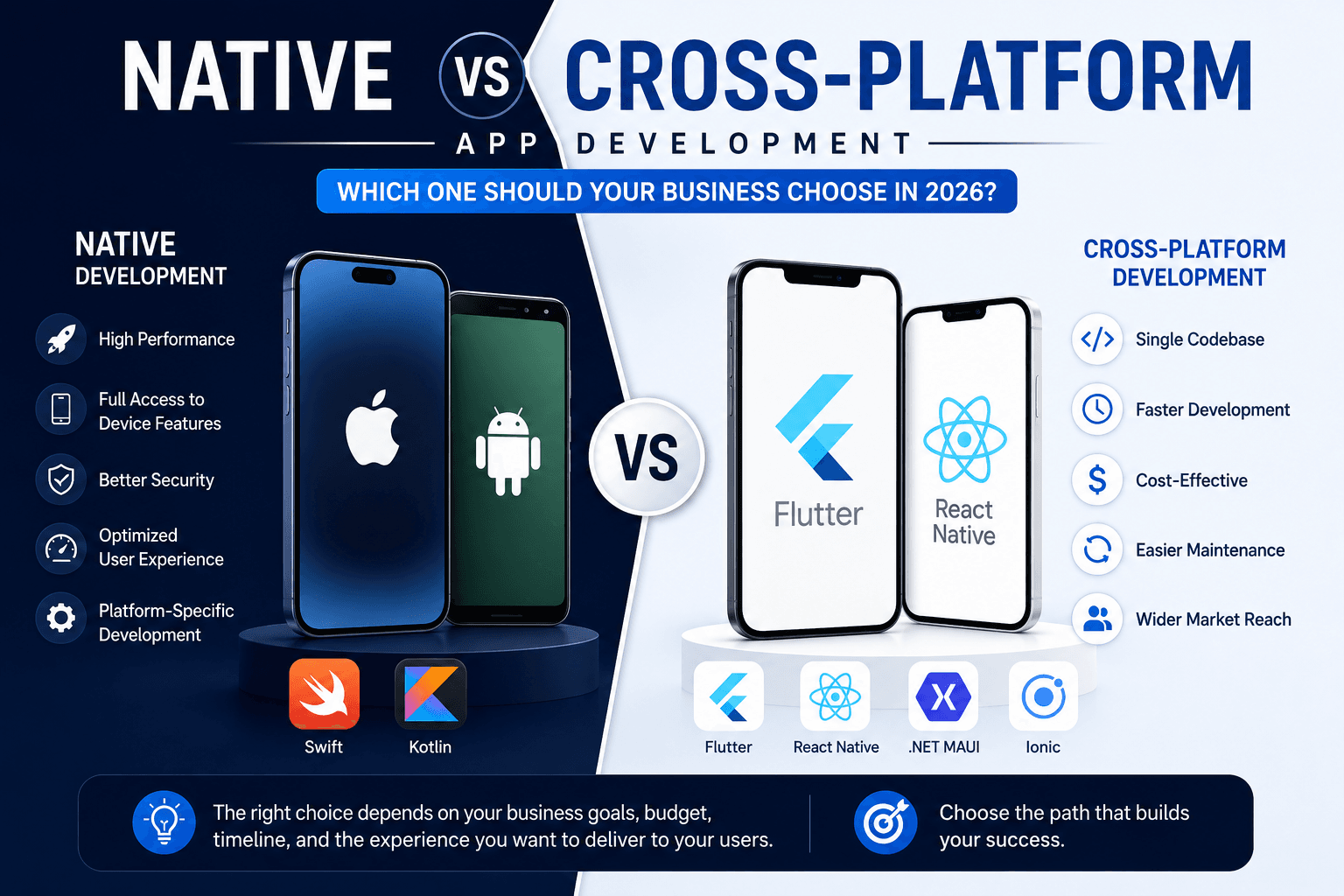
Building a mobile application is one of the most important technology investments a business can make in 2026. Mobile apps help companies engage customers, increase revenue, improve brand loyalty, and streamline operations. However, before starting development, businesses must make a critical decision: should they choose native app development or cross-platform app development?
The answer is not always straightforward. Both approaches have unique advantages, limitations, costs, and long-term implications.
Choosing the wrong development strategy can lead to higher costs, slower performance, maintenance challenges, and missed business opportunities. On the other hand, selecting the right approach can significantly reduce development costs, speed up time-to-market, and improve user satisfaction.
In this comprehensive guide, we will compare native and cross-platform app development, explain their differences, discuss their advantages and disadvantages, and help you determine which option is best for your business.
What Is Native App Development?
Native app development refers to building applications specifically for a single operating system using platform-specific programming languages and tools.
For example:
Android Native Development
Android applications are typically developed using:
- Kotlin
- Java
Development tools include:
- Android Studio
- Android SDK
iOS Native Development
iPhone and iPad applications are typically developed using:
- Swift
- Objective-C
Development tools include:
- Xcode
- Apple SDK
When developing natively, separate applications are built for Android and iOS.
This means developers create independent codebases optimized for each platform.
What Is Cross-Platform App Development?
Cross-platform development allows developers to create a single codebase that works across multiple platforms.
Instead of building separate Android and iOS applications, developers write code once and deploy it to both platforms.
Popular cross-platform frameworks include:
- Flutter
- React Native
- .NET MAUI
- Ionic
Among these, Flutter has become one of the most popular choices in recent years due to its performance, flexibility, and growing ecosystem.
Cross-platform development aims to reduce development costs while maintaining a consistent user experience across devices.
Native vs Cross-Platform: Understanding the Core Difference
The primary difference lies in how applications are built and maintained.
Native Development
- Separate codebases
- Platform-specific development
- Maximum optimization
- Better hardware integration
Cross-Platform Development
- Single codebase
- Shared business logic
- Faster development
- Lower development costs
Understanding this distinction is essential when evaluating project requirements.
Performance Comparison
Performance is often the first factor businesses consider.
Native App Performance
Native applications generally offer the highest level of performance.
Benefits include:
- Faster execution
- Smoother animations
- Better memory management
- Lower latency
- Improved responsiveness
Because native apps communicate directly with the operating system, they can fully utilize device resources.
This makes native development ideal for:
- Gaming applications
- Video editing apps
- AR/VR applications
- Real-time communication platforms
- High-performance financial applications
Cross-Platform Performance
Modern frameworks have significantly improved performance.
Flutter, in particular, delivers near-native performance in many scenarios.
However, cross-platform applications may still encounter challenges when handling:
- Intensive graphics processing
- Complex animations
- Advanced hardware interactions
- High-frequency real-time operations
For most business applications, users rarely notice performance differences.
Development Cost Comparison
Budget is often one of the most important considerations.
Native Development Costs
Native development typically requires:
- Separate Android developers
- Separate iOS developers
- Separate testing processes
- Separate maintenance cycles
As a result, development costs are usually higher.
Estimated Cost Range:
$20,000 to $300,000+
Depending on project complexity.
Cross-Platform Development Costs
Cross-platform development uses a shared codebase.
Benefits include:
- Fewer developers required
- Faster development cycles
- Reduced testing efforts
- Simplified maintenance
Estimated Cost Savings:
20% to 50% compared to native development.
This makes cross-platform development particularly attractive for startups and small businesses.
Time to Market
Launching quickly can provide a significant competitive advantage.
Native Development Timeline
Since separate applications are built, development takes longer.
Teams must:
- Create two codebases
- Test two applications
- Maintain two versions
Typical Timeline:
4 to 12 months
Cross-Platform Timeline
Developers write code once and deploy to multiple platforms.
Typical Timeline:
2 to 8 months
Businesses looking for rapid market entry often prefer cross-platform solutions.
User Experience and Design
User experience plays a crucial role in app success.
Native User Experience
Native applications naturally follow platform-specific design standards.
Examples include:
- Apple’s Human Interface Guidelines
- Google’s Material Design
Benefits:
- Familiar user experience
- Platform consistency
- Improved usability
Users often perceive native applications as more polished.
Cross-Platform User Experience
Modern frameworks allow highly customized interfaces.
Flutter, for example, can replicate native experiences quite effectively.
However, developers must carefully design applications to ensure consistency across platforms while respecting platform conventions.
Access to Device Features
Many applications rely on smartphone hardware and operating system capabilities.
Native Development Advantages
Native applications have direct access to:
- Camera
- GPS
- Bluetooth
- NFC
- Sensors
- Face ID
- Fingerprint authentication
New operating system features are typically available first to native developers.
Cross-Platform Limitations
Most modern frameworks support major device features.
However, newly released platform-specific capabilities may require:
- Additional plugins
- Custom native code
- Framework updates
For businesses heavily dependent on advanced hardware integration, native development may be preferable.
Maintenance and Updates
Every application requires ongoing maintenance.
Native Maintenance
Native development involves maintaining multiple codebases.
This often means:
- More development hours
- Higher support costs
- Increased testing requirements
Every feature update must be implemented separately.
Cross-Platform Maintenance
A shared codebase simplifies maintenance.
Benefits include:
- Faster bug fixes
- Easier updates
- Lower long-term costs
- Consistent feature releases
Many businesses save substantial resources through simplified maintenance.
Security Considerations
Security is increasingly important for modern applications.
Native Security
Native applications benefit from platform-specific security features.
Advantages include:
- Advanced encryption
- Secure hardware integration
- Faster access to security updates
This makes native development particularly attractive for:
- Banking applications
- Healthcare platforms
- Government systems
Cross-Platform Security
Cross-platform applications can still achieve strong security standards.
However, security implementation may depend on:
- Framework quality
- Third-party libraries
- Development practices
When properly developed, cross-platform applications can be highly secure.
Scalability
Businesses should consider future growth.
Native Scalability
Native applications often provide maximum flexibility for future expansion.
Advantages include:
- Better architecture control
- Advanced optimization
- Easier integration of platform-specific innovations
Cross-Platform Scalability
Modern frameworks support large-scale applications.
Many successful global products use cross-platform technologies.
However, extremely complex applications may eventually require native optimization.
Flutter vs Native Development
Flutter has become one of the most discussed frameworks in app development.
Advantages of Flutter
- Single codebase
- Fast development
- Beautiful UI
- Strong performance
- Hot reload functionality
- Lower costs
Advantages of Native Development
- Maximum performance
- Full platform integration
- Better access to new operating system features
- Enhanced optimization
For many startups and businesses, Flutter provides an excellent balance between cost and performance.
When Should You Choose Native App Development?
Native development is often the best choice when:
You Need Maximum Performance
Examples:
- Gaming applications
- AR applications
- Video editing platforms
You Require Advanced Hardware Access
Examples:
- Medical devices
- IoT systems
- Specialized industrial applications
Your Budget Is Flexible
Native development generally requires larger investments.
User Experience Is Critical
Premium consumer applications often benefit from native development.
When Should You Choose Cross-Platform Development?
Cross-platform development is ideal when:
You Have Budget Constraints
Startups often need to maximize resources.
Cross-platform development can reduce costs significantly.
You Need Faster Launches
Rapid market validation is essential for many businesses.
Your App Targets Both Android and iOS
Maintaining a single codebase simplifies operations.
You Want Easier Maintenance
Long-term maintenance costs are typically lower.
Common Myths About Cross-Platform Development
Myth 1: Cross-Platform Apps Are Slow
Modern frameworks such as Flutter offer excellent performance.
Most users cannot distinguish between Flutter and native apps.
Myth 2: Cross-Platform Apps Look Generic
Today’s frameworks provide extensive design flexibility.
Businesses can create highly customized interfaces.
Myth 3: Native Development Is Always Better
The best choice depends on business goals, budget, and technical requirements.
Many successful companies use cross-platform solutions.
Real-World Examples
Applications Commonly Built Natively
- Mobile games
- Banking applications
- Video editing tools
- AR platforms
Applications Commonly Built with Cross-Platform Frameworks
- Startup products
- Business apps
- eCommerce apps
- Booking systems
- Educational platforms
- Healthcare portals
Both approaches have proven successful across various industries.
Questions to Ask Before Choosing
Before selecting a development approach, consider:
- What is your budget?
- What is your timeline?
- How important is performance?
- Do you require advanced device features?
- What are your long-term scalability plans?
- How frequently will the app be updated?
- What platforms do your customers use?
Answering these questions can clarify the best path forward.
Future Trends in Mobile App Development
The gap between native and cross-platform development continues to narrow.
Key trends shaping 2026 include:
- AI-powered development tools
- Improved Flutter performance
- Better framework ecosystems
- Enhanced cross-platform capabilities
- Faster deployment workflows
Many businesses now view cross-platform development as a strategic advantage rather than a compromise.
The choice between native and cross-platform app development depends entirely on your business objectives, budget, timeline, and technical requirements.
Native development delivers the highest performance, deepest platform integration, and maximum flexibility. It is often the preferred option for large enterprises, gaming companies, and applications requiring advanced hardware capabilities.
Cross-platform development offers faster development, lower costs, simplified maintenance, and broader market reach. For startups, small businesses, and many growing companies, frameworks like Flutter provide an excellent balance of quality and affordability.
There is no universal solution that works for every project. The most successful businesses carefully evaluate their goals and choose the development strategy that aligns with their long-term vision.
If you are planning to build a mobile application in 2026, consulting with an experienced mobile app development company can help you determine whether native or cross-platform development is the best fit for your project and ensure a successful launch.