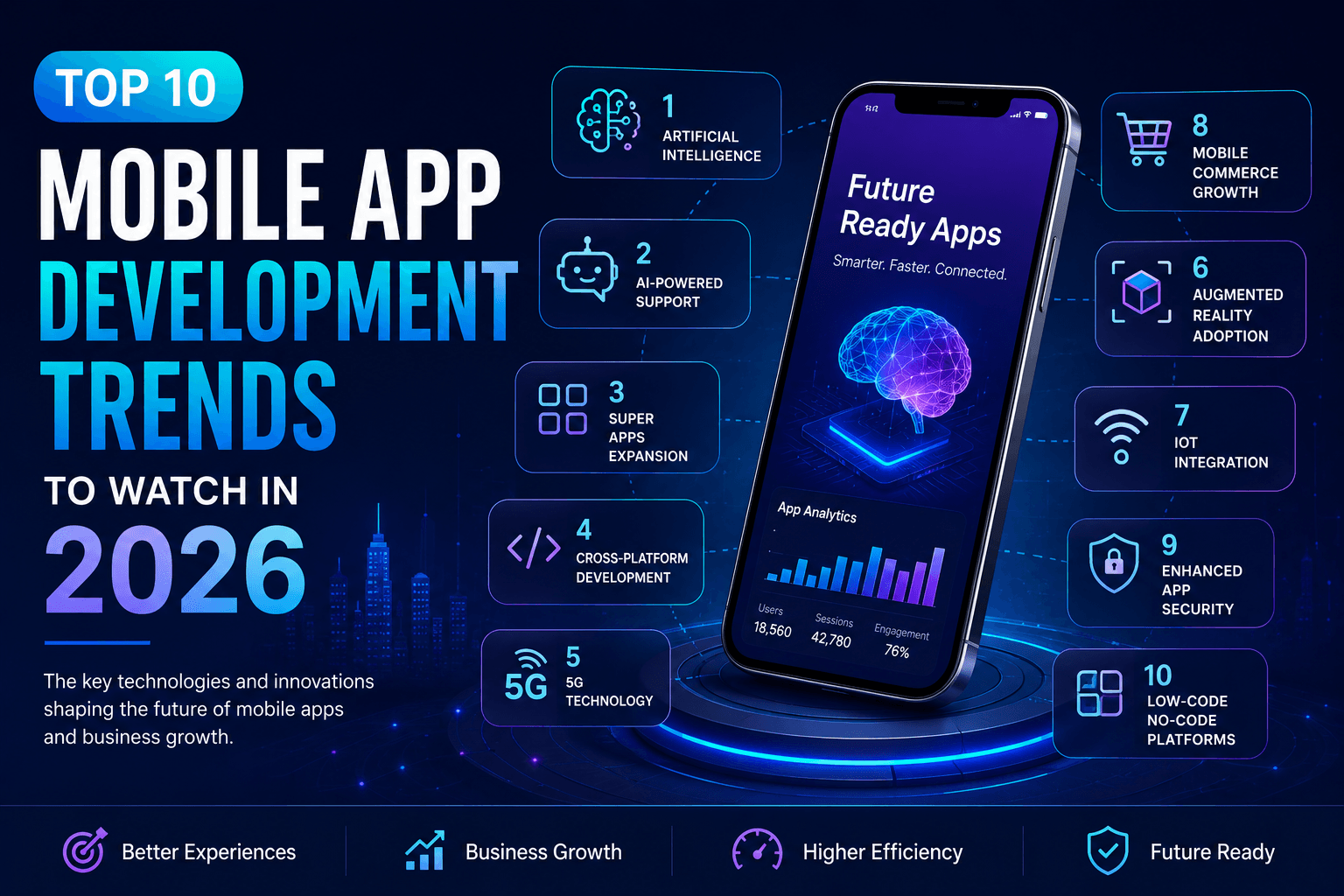
The mobile app industry continues to evolve at an incredible pace. As smartphones become more powerful and user expectations rise, businesses must stay ahead of technological advancements to remain competitive. Companies that embrace emerging mobile app development trends often gain significant advantages in customer engagement, operational efficiency, and market growth.
In 2026, mobile applications are no longer just digital tools. They have become intelligent business platforms powered by artificial intelligence, cloud computing, automation, and immersive experiences. Consumers now expect faster, smarter, and more personalized interactions from the apps they use every day.
Whether you’re a startup founder, business owner, product manager, or technology leader, understanding the latest mobile app development trends can help you make informed decisions about future investments.
In this article, we’ll explore the top 10 mobile app development trends shaping the industry in 2026 and explain how businesses can benefit from them.
Why Mobile App Trends Matter
Technology evolves rapidly. Features that seemed innovative a few years ago are now considered standard.
Businesses that ignore emerging trends may face challenges such as:
- Reduced customer engagement
- Lower app retention rates
- Increased competition
- Outdated user experiences
- Missed revenue opportunities
On the other hand, organizations that embrace innovation can create apps that stand out in crowded marketplaces and provide exceptional user experiences.
Let’s examine the trends driving mobile app development in 2026.
1. Artificial Intelligence Becomes a Standard Feature
Artificial Intelligence (AI) has moved beyond being a futuristic concept. In 2026, AI is becoming a core component of modern mobile applications.
AI helps applications:
- Understand user behavior
- Deliver personalized experiences
- Automate repetitive tasks
- Improve customer support
- Generate intelligent recommendations
Popular AI Features in Mobile Apps
Businesses are increasingly integrating:
- AI chatbots
- Smart assistants
- Recommendation engines
- Predictive analytics
- Image recognition
- Voice recognition
- Content generation tools
Business Benefits
AI-powered applications can:
- Increase customer satisfaction
- Improve conversion rates
- Reduce operational costs
- Deliver personalized experiences at scale
As AI technologies continue to mature, businesses that leverage them effectively will gain a significant competitive advantage.
2. AI-Powered Customer Support and Virtual Assistants
Customers expect immediate responses.
Traditional support teams often struggle to handle increasing customer demands.
AI-powered virtual assistants are helping businesses solve this challenge.
Modern virtual assistants can:
- Answer common questions
- Process orders
- Schedule appointments
- Provide technical support
- Handle customer onboarding
Unlike earlier chatbot generations, today’s AI assistants understand context and provide more natural conversations.
Benefits include:
- Faster support
- Reduced staffing costs
- Improved customer experience
- 24/7 availability
Many successful mobile applications now include AI-driven support as a standard feature.
3. Super Apps Continue to Expand
A super app combines multiple services within a single application.
Instead of using separate apps for messaging, shopping, payments, transportation, and entertainment, users can access everything from one platform.
Why Super Apps Are Growing
Consumers increasingly prefer convenience.
Super apps offer:
- Unified user experiences
- Simplified account management
- Integrated payments
- Higher engagement
Examples of super app features include:
- Messaging
- E-commerce
- Food delivery
- Ride booking
- Financial services
- Loyalty programs
Businesses are increasingly exploring super app models to increase user retention and revenue opportunities.
4. Cross-Platform Development Dominates New Projects
Cross-platform development continues to gain popularity in 2026.
Frameworks such as Flutter allow developers to create Android and iOS applications from a single codebase.
Why Businesses Prefer Cross-Platform Development
Advantages include:
- Faster development
- Lower costs
- Easier maintenance
- Consistent user experience
For startups and growing businesses, launching simultaneously on multiple platforms is often critical.
Cross-platform frameworks now deliver performance levels that are very close to native applications.
As a result, many organizations view cross-platform development as the most efficient approach for modern app projects.
5. 5G Technology Unlocks New Possibilities
The global rollout of 5G networks is transforming mobile experiences.
Compared to previous generations, 5G offers:
- Faster speeds
- Lower latency
- Improved reliability
- Higher network capacity
Impact on Mobile Applications
Developers can now create more sophisticated experiences, including:
- High-quality video streaming
- Real-time gaming
- AR experiences
- Cloud-based applications
- Live collaboration tools
Businesses can leverage 5G to deliver richer and more interactive experiences without compromising performance.
6. Augmented Reality (AR) Goes Mainstream
Augmented Reality has matured significantly over the past few years.
Rather than being limited to gaming applications, AR is now widely used across industries.
Popular AR Use Cases
Retail:
- Virtual product previews
- Try-before-you-buy experiences
Real Estate:
- Virtual property tours
Healthcare:
- Medical visualization
Education:
- Interactive learning environments
Manufacturing:
- Technical training and maintenance support
Why AR Matters
AR helps users visualize products and information within their real-world environment.
Benefits include:
- Better engagement
- Improved purchase confidence
- Higher conversion rates
- Enhanced learning experiences
Businesses investing in AR can create highly memorable customer interactions.
7. Internet of Things (IoT) Integration Expands
The Internet of Things continues to connect everyday devices to mobile applications.
Examples include:
- Smart homes
- Wearable devices
- Connected vehicles
- Industrial sensors
- Healthcare devices
Mobile apps increasingly serve as control centers for connected ecosystems.
Business Opportunities
IoT-powered mobile applications enable:
- Remote monitoring
- Predictive maintenance
- Smart automation
- Real-time data collection
Industries such as healthcare, logistics, manufacturing, and energy are benefiting significantly from IoT integration.
As connected devices become more common, demand for IoT-enabled mobile applications will continue growing.
8. Mobile Commerce Continues to Accelerate
Mobile commerce, often called m-commerce, remains one of the fastest-growing segments of the digital economy.
Consumers increasingly prefer shopping through mobile devices.
Key Mobile Commerce Trends
Businesses are investing in:
- One-click purchasing
- Mobile wallets
- Personalized recommendations
- AI-driven shopping assistants
- Loyalty programs
- Social commerce integration
Why It Matters
A well-designed mobile shopping experience can significantly improve:
- Conversion rates
- Average order value
- Customer retention
- Brand loyalty
Companies that prioritize mobile commerce will be better positioned for long-term growth.
9. Enhanced Mobile App Security
Cybersecurity is becoming a top priority for businesses and consumers alike.
As applications handle more sensitive information, security requirements continue to increase.
Security Features Trending in 2026
Businesses are implementing:
- Multi-factor authentication
- Biometric authentication
- End-to-end encryption
- Secure cloud infrastructure
- Behavioral analytics
- Fraud detection systems
Importance for Businesses
Strong security helps:
- Protect customer data
- Build trust
- Meet compliance requirements
- Prevent financial losses
Users are increasingly choosing applications that demonstrate strong privacy and security practices.
10. Low-Code and No-Code Development Adoption
Low-code and no-code platforms are changing how businesses approach software development.
These tools allow applications to be created using visual interfaces rather than extensive coding.
Benefits
Organizations can:
- Build prototypes faster
- Reduce development costs
- Accelerate innovation
- Enable non-technical teams to contribute
Limitations
While low-code platforms are valuable for certain use cases, complex enterprise applications often still require professional development teams.
However, low-code solutions are becoming increasingly important for:
- Internal business tools
- Workflow automation
- Rapid prototyping
- MVP development
Many organizations now combine traditional development with low-code solutions to improve efficiency.
Additional Trends Worth Monitoring
Beyond the top ten trends, several emerging technologies are attracting attention.
Voice User Interfaces
Voice-based interactions continue to improve through advances in AI and natural language processing.
Blockchain Integration
Businesses are exploring blockchain for:
- Secure transactions
- Digital identity verification
- Asset management
Wearable Applications
Smartwatches and wearable devices continue expanding the mobile ecosystem.
Edge Computing
Processing data closer to users reduces latency and improves application performance.
These technologies may become even more influential in the coming years.
How Businesses Can Prepare for the Future
Understanding trends is only the first step.
Successful organizations actively prepare for technological change.
Invest in Scalable Architecture
Applications should be designed with future growth in mind.
Scalable architecture allows businesses to add new features without major disruptions.
Prioritize User Experience
No matter how advanced technology becomes, user experience remains critical.
Businesses should focus on:
- Simplicity
- Speed
- Accessibility
- Reliability
Embrace Data-Driven Decision Making
Analytics provide valuable insights into user behavior.
Organizations that use data effectively can improve engagement and optimize performance.
Work with Experienced Development Teams
Technology evolves quickly.
Partnering with experienced mobile app developers helps businesses adopt emerging technologies while minimizing risks.
The Future of Mobile App Development
Looking beyond 2026, mobile applications will likely become even more intelligent, connected, and personalized.
Future developments may include:
- Advanced AI assistants
- Fully immersive AR experiences
- Autonomous digital services
- Smarter IoT ecosystems
- Predictive user interfaces
Businesses that adapt early will be best positioned to capitalize on these opportunities.
Final Thoughts
The mobile app industry is entering an exciting period of innovation. Artificial intelligence, augmented reality, IoT integration, 5G connectivity, enhanced security, and cross-platform development are transforming how applications are built and used.
Businesses that embrace these trends can create more engaging experiences, improve customer satisfaction, and unlock new revenue opportunities.
While not every trend will be relevant to every organization, understanding the direction of the industry is essential for making informed technology decisions.
As competition continues to intensify, companies that invest in modern mobile app development strategies will be better prepared to meet customer expectations and succeed in the digital economy.
Whether you’re planning a new mobile application or upgrading an existing product, keeping an eye on these trends will help ensure your business remains competitive throughout 2026 and beyond.